
Hope
& Emily Dickinson

In our mad, bad, modern world, hope is often illusive. It is all too often so painful that hope seems a betrayal of ‘truth’ in a seemingly dystopian reality. Yet without hope, without feeling and helping to make the world around us better – however and wherever we find it – we become less human.
One of my favourite poets is Emily Dickinson (1830–1886). If Emily Dickinson harboured ambitions as a renowned poet in her lifetime, those ambitions went unrequited. If she had hoped for other public achievements, her life would have only been remembered by her immediate family and friends.
So, how did her poems live on? Back in 1862, in her opening correspondence with a man of letters she challenged him to tell her whether her verse ‘breathed’ – yet only those in her close circle of friends and family ever saw her poems whilst she lived. After Emily’s death, her younger sister Lavinia found a box with the stitched fascicles and other poetic manuscripts. Fortunately for posterity, she resolved to display Emily’s genius to the world. But Lavinia was no writer and eventually enlisted Mabel Loomis Todd, a friend and their brother William Austin’s mistress, to edit them. Poems by Emily Dickinson (1890) and Poems by Emily Dickinson (1891) were the result. Todd alone then responded to public interest by publishing an 1894 edition of selected Dickinson letters and a third collection of Poems in 1896. Roberts Brothers of Boston brought out all four volumes, the first of which sold out rapidly with eleven editions printed within a year. And the rest is history. . .
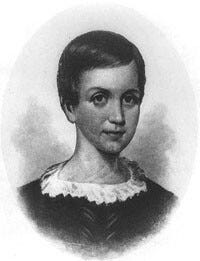
(Library of Congress: Frontispiece Letters of Emily Dickinson, 1894)
Dickinson’s poetry distils both emotional and intellectual energy into a condensed and sublime form. Her longest poem is less than two printed pages. Her words and phrases are set off by dashes; her stanzas are brief. Yet, somehow in very few words she creates a daring expression of the ‘soul’s extremities’. She used symbolically freighted words such as ‘Circumference’ – or the use of the oxymoron in ‘Heavenly Hurt’ or ‘sumptuous Despair’ making us feel and be involved with her on a personal level. Her imagery was wide ranging: from domestic and garden metaphors to geographic and scientific references drawn from her education. Literary allusions to the Bible, Shakespeare, Dickens, and the Brontës are dutiful nods to her beloved sources. Her poems express extremes of passion – love, despair, dread, and elation – changing the point of view and voice from a bride, nobleman, madwoman, child or even a corpse.
On this Easter Sunday, I feel it is only appropriate to address the notion of ‘hope’ or as the Oxford English Dictionary defines it: The expectation of something desired. For most of us, that would be peace and a better world. And for my money, no one wrote a better poem about hope than Emily Dickinson:
“Hope” is the thing with feathers -
That perches in the soul -
And sings the tune without the words -
And never stops - at all -
And sweetest - in the Gale - is heard -
And sore must be the storm -
That could abash the little Bird
That kept so many warm -
I’ve heard it in the chillest land -
And on the strangest Sea -
Yet - never - in Extremity,
It asked a crumb - of me.
Wishing you all peace, hope and happiness this Easter.
Bootiful and what we all need in bucket loads right now! Rx